This article may contain affiliate links. If you purchase through a link, I may earn a small commission at no extra cost to you. Read my full Affiliate Disclosure.
I spent three years staring at my apartment kitchen feeling like something was missing – and for two of those years, I kept buying things. A new fruit bowl. Prettier dish towels. That ceramic canister set I saw in approximately four hundred Pinterest photos. And every single time, the room still felt cold and kind of depressing, like a short-term rental that nobody actually lived in.
The cozy kitchen aesthetic I was chasing wasn’t about more stuff. That took me embarrassingly long to figure out. This guide is everything I’ve learned since – about what actually creates warmth in a small apartment kitchen, what most decorating advice gets completely backwards, and how to do it without drilling a single hole in your rental walls.
Table of Contents :
Your Quick-Start Plan for a Cozy Kitchen Aesthetic
Before you buy anything, here’s the honest overview of how this actually works – start to finish:
- Phase 1: Audit the light first. Walk your kitchen at different times of day. Whatever lighting problem you have, you can’t style your way around it – you solve it first.
- Phase 2: Fix what you already own. Edit, rearrange, and remove before adding. Most kitchens need subtraction more than addition.
- Phase 3: Anchor with one warm material. Choose one thing – wood cutting boards, a jute runner, a rattan pendant – and build outward from its tone.
- Phase 4: Layer your lighting. Get at least one warm non-overhead light source in the room before spending on decor.
- Phase 5: Bring in living things. One or two plants (or even a simple herb pot) do more for warmth than almost any decorative object.
- Phase 6: Stop before it’s “finished.” Cozy spaces usually need one fewer thing than you think they do.
The Mistake Almost Everyone Makes With Cozy Kitchen Aesthetic
Here’s what I believed for years: a cozy kitchen is about what you put in it. The right accessories. The right colors. The perfectly curated open shelf.
Wrong. Or – not exactly wrong, but so far down the list of what actually matters that spending money there first is almost always a waste.
The real issue in most apartment kitchens is lighting. Specifically: one harsh overhead fixture doing all the work and doing it badly. When designers talk about layered lighting – using multiple sources at different heights and intensities instead of relying on a single overhead – they’re describing exactly what separates a kitchen that feels like a hospital break room from one that feels like a place you actually want to be.
Warm-toned bulbs in the 2700-2900K range make an immediate, visible difference. I swapped the cool-white bulbs in my overhead fixture and within a week my partner asked if I’d painted the walls. I hadn’t touched a thing. That’s how much light temperature changes a room’s feeling.
The reason this mistake is so common makes total sense: lighting is invisible in the “before” photo. Nobody pins a picture of a pendant light and says “this is the whole secret.” But it almost always is.
How to Build a Cozy Kitchen Aesthetic: What Actually Works
Start With Warmth at the Right Kelvin
Overhead kitchen lighting is almost always designed for function – bright, cool, shadowless. It’s genuinely useful for cooking. It is the enemy of cozy. The fix isn’t to sacrifice task lighting; it’s to layer sources so you can choose your mood.
If your kitchen has a ceiling fixture, swap its bulbs for something in the 2700-3000K range – warm white, almost amber at the lower end. Then add at least one additional source that isn’t overhead: a small plug-in under-cabinet light, a clip-on lamp on top of your refrigerator pointed toward the ceiling, a battery-operated puck light tucked behind your stand mixer. These don’t need to be expensive. They need to exist.
The difference between a kitchen lit by one overhead fixture and one with two or three layered sources is honestly hard to overstate. I didn’t believe it until I lived it. My kitchen didn’t change at all – same cabinets, same counters, same everything – but the lighting shift made it feel like a completely different room by 7pm.
One practical check: stand in your kitchen at dusk with just the overhead on, and then with the overhead off and only a warm secondary source. If the second option feels more like a place you want to linger, you have your answer.
The Wood Tones Problem Nobody Warns You About
Okay, I have a strong opinion about this one. When people picture a dark cozy kitchen aesthetic – warm wood, aged brass, earthy ceramics – they often end up with a mismatch of undertones that makes the whole thing feel muddy instead of intentional.
Wood tones run warm (orange, red, honey) and cool (gray, ash, bleached). Mixing them isn’t automatically bad – but mixing them without knowing you’re doing it usually is. A cool gray-toned floating shelf next to warm honey-toned cutting boards next to a whitewashed rattan basket creates visual noise. Your eye can’t settle anywhere. Nothing reads as a choice.
What designers call repetition – echoing a material, tone, or finish across multiple elements in a room – is what makes a kitchen feel curated rather than collected. Pick your wood direction (warm or cool) and stay in that lane for your main pieces. You can add contrast through matte black hardware, aged brass, or natural linen – but keep the wood tones cohesive.
I got this wrong for years. My first apartment kitchen had four different wood tones and I kept wondering why it never looked like the photos I was trying to recreate. The photos had two, maybe three materials repeated throughout. Mine had twelve.
Texture Does More Work Than Color
The visual warmth in a cozy kitchen aesthetic – that feeling of softness and depth that makes you want to stay – comes more from texture than color. This surprised me when I finally understood it.
Rough woven jute, smooth cool ceramic, soft worn linen, the matte grip of an unglazed pot, the warm weight of a wooden board – these are the things that tell your nervous system “this is a place to slow down.” Color matters, but warm earthy tones in a bare, slick, hard-surfaced kitchen still read as cold. The same creamy white with layered texture reads as inviting.
For rental kitchens specifically, texture is your main tool because most of it is removable. A jute or cotton runner on the floor. Linen dish towels folded over the oven handle. A wooden cutting board leaned against the backsplash. Ceramic canisters with an unglazed matte finish. None of these require permission. All of them shift the sensory quality of the space.
Quick note on jute specifically: it sheds. More than you expect. It’s beautiful and natural and it will absolutely leave fibers on your kitchen floor for the first few months. If that’s going to drive you crazy, a washable cotton runner gives you similar warmth with much easier maintenance.
Open Shelving: The Honest Truth About Whether It Works for You
Open shelving is everywhere in cozy kitchen aesthetic inspiration photos. It’s also the most high-maintenance thing you can do to a kitchen and nobody talks about that enough.
Grease floats. Dust settles. Whatever is on your open shelves will need wiping down regularly – more than you’re probably imagining right now. If your cooking style involves anything that splatters (which, most cooking does), everything within a few feet of your stove will need attention every week or two.
That said, a single styled shelf done well does something nothing else can: it gives you vertical visual interest and a place to display the few things that actually say “a person who loves this kitchen lives here.” The key is editing ruthlessly. Not the shelf with fifteen items. The shelf with five, where every item earns its place either by being beautiful, functional, or both.
For renters: floating shelves require drilling. If that’s not an option, a freestanding narrow bookshelf or a baker’s rack achieves nearly the same look with zero wall damage. And if you do have permission to drill, use a stud finder – please – and patch your holes properly when you move out.
One more thing I learned the hard way about wood shelves specifically: the finish matters as much as the wood species. A properly sealed shelf – sealed all sides, not just the top – survives kitchen humidity for years. An unsealed one warps within a season. If you’re buying raw wood, seal it yourself before mounting. It takes an afternoon and saves a lot of frustration.
Honest Truths About Cozy Kitchen Aesthetic I Learned the Hard Way
The plants will die if your kitchen doesn’t have enough light. I cannot tell you how many pothos I’ve martyred to a windowless kitchen corner because I wanted greenery and refused to accept my light conditions. If your kitchen doesn’t have a window – or has one that faces a wall – you need either a grow light (which looks less cozy than you’d hope) or very forgiving low-light plants like a ZZ plant or snake plant near the edge of the kitchen, not deep inside it. Fake plants have gotten genuinely good in recent years. There, I said it.
The “cozy kitchen aesthetic vintage” look costs more than it looks like it does. Thrifted ceramics and antique finds can absolutely get you there for less, but hunting takes real time. If you’re sourcing vintage items online for convenience, the prices are often higher than new equivalents. The look is achievable on a budget – it just requires patience and local thrift store visits, not a quick online cart.
I spent real money on this and it still felt wrong for months. Not a small amount – a full kitchen refresh, new everything, careful planning. And for about six months it felt like a room I was trying to convince myself I liked rather than one I actually did. What finally shifted it wasn’t another purchase. It was removing things. Taking the excess off the counter. Giving some of what I’d bought away. The cozy small kitchen aesthetic I was after had breathing room in it. My version was too full. That was a hard thing to admit after spending what I spent.
Contact paper is better than it used to be – but it’s still contact paper. Removable contact paper on cabinets or as a backsplash alternative has genuinely improved. But application is finicky (bubbles are real), removal can pull paint if your surfaces aren’t well-sealed, and it can look great in photos and slightly cheap in person depending on the pattern and finish you choose. Test a small piece in an inconspicuous area first, always.
Budget-Friendly Cozy Kitchen Aesthetic Checklist
- [ ] At least one warm-toned light source added (under-cabinet, plug-in, or bulb swap to 2700-3000K)
- [ ] Counter surfaces edited – no more than 3-5 items visible at any given time
- [ ] One natural material anchoring the look (wood, jute, rattan, ceramic)
- [ ] Wood tones cohesive – warm or cool, not mixed randomly
- [ ] At least two different textures present (not just color variation)
- [ ] One living thing on the counter or windowsill (plant, herb pot, or convincing alternative)
- [ ] Floor covered or softened if flooring is cold or institutional-looking
- [ ] No open-shelf chaos – if shelves exist, edited to 5 or fewer items per shelf
Making the Cozy Kitchen Aesthetic Work in Your Actual Apartment
Different situations call for different starting points. Here’s how I’d approach it depending on where you’re at:
If you’re renting and can’t modify anything: Your tools are textiles, lighting, and freestanding pieces. A plug-in pendant light (hang it from a ceiling hook with an adhesive strip rated for the weight), a cotton or jute runner, removable peel-and-stick wallpaper on the inside of a cabinet or as a small accent panel, and a freestanding baker’s rack or wooden cart for extra warmth and storage. Budget priority: the lighting first, under $50 if you shop carefully, and it changes more than anything else.
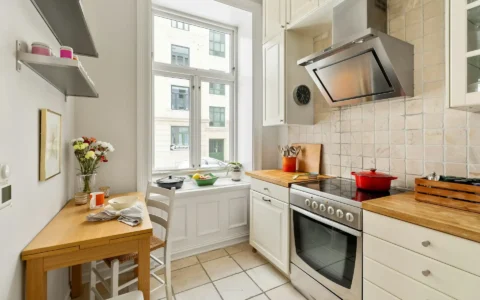
If your kitchen is very small: Edit before you add anything. The instinct is always to add warmth – more objects, more texture, more stuff. But in a tiny kitchen, cozy and cluttered are separated by a very thin line. One beautiful wooden cutting board leaned against the backsplash does more for the aesthetic than seven small accessories competing for attention. Negative space – the breathing room between objects – is what makes small spaces feel intentional rather than cramped.
If you’re starting from scratch with a real budget: The one piece worth investing in is a quality wooden butcher block cart or island if your space allows it. Real solid wood, not veneer over particle board – the difference in how it ages is significant, and a cart you can move around is renter-friendly by design. Expect to spend $150-350 for something that lasts.
If your partner has completely different taste: Find the overlap. Usually it’s something functional – a coffee station, a designated cooking zone, a better lighting situation. Start there. Cozy small kitchen ideas almost always have a functional core that even skeptics appreciate once they’re living with it.
If you’re staring at your kitchen right now feeling overwhelmed: don’t start with shopping. Start by taking one thing off your counter and living with that for a week. Seriously. That moment of “oh – it already looks a little better” is the thing that shows you what direction to go.
Your Cozy Kitchen Aesthetic Questions, Answered Honestly
Q: How do I make my apartment kitchen look cozy when it has white or gray builder-grade cabinets?
A: You work with them rather than against them. White and gray cabinets are actually a great neutral base – the warmth comes from everything else. Hardware swaps (aged brass or matte black) make a visible difference if your lease allows small changes, and most landlords don’t count hardware as a modification. Warm wood tones on the counter (a cutting board, a tray, a wooden utensil crock) and warm-toned lighting do the rest. The cabinets don’t need to be beautiful – they just need to not fight with everything else.
Q: Is dark cozy kitchen aesthetic possible in a small space?
A: It depends on your light. In a kitchen with good natural light, moody dark tones – deep green, charcoal, dark wood – can look genuinely stunning even in a small space. In a kitchen with minimal natural light, going dark can make the room feel smaller and heavier than you want. The honest answer is: try one thing first. A dark-painted accent wall (if you’re allowed), a deep-toned open shelf, a charcoal runner. Live with it before committing further. Your kitchen’s light situation is the variable that determines whether this works.
Q: What’s actually worth spending money on for a cozy kitchen aesthetic on a small budget?
A: In order of impact: lighting (a plug-in pendant or warm-toned bulb swap), one quality natural material item (a real wooden board or bowl, not laminate), and a plant or herb pot with good light conditions. Everything else – ceramic canisters, dish towels, small accessories – is worth thrifting or buying on the lower end because the cozy look comes from the combination, not from any single expensive piece.
Q: Does peel-and-stick wallpaper actually look good in a kitchen?
A: It can, with caveats. It looks best on smooth, well-sealed surfaces. It’s less forgiving on textured walls or old paint that’s slightly soft. For a rental kitchen, the safest placement is inside a cabinet door (open it and you see the pattern – close it and there’s no risk to your deposit) or as an accent panel on a section of wall that isn’t behind the stove or sink. Avoid steam-heavy areas. The patterns that tend to work best for a cozy kitchen aesthetic are small-scale botanicals, simple geometric tiles, or soft vintage florals – nothing too bold that you’ll regret in three months.
You Can Check Also :
Small Living Room Layout Mistakes to Avoid (And What to Do Instead)
The Ultimate Guide to Decorating Your Living Room on a Budget
The Thing About Cozy Kitchens That Nobody Really Says Out Loud
The cozy kitchen aesthetic you’re working toward isn’t a finish line. I know that’s not what anyone wants to hear, but it’s the thing I wish I’d understood earlier. The kitchens that actually feel warm and lived-in and like a real place where real people make real food – those spaces were built slowly. Over seasons. With things that came from grandmothers’ houses and farmers markets and thrift stores found on ordinary Saturdays.
You can absolutely create a genuinely cozy kitchen aesthetic in an apartment rental, with a limited budget, starting now. The principles are real and they work. But the spaces that look effortlessly warm in photos usually have one thing yours is still building: time. The wooden spoon that’s gotten dark at the handle from years of use. The ceramic bowl that chips a little but you keep it because it was a gift. The plant that’s survived three apartments.
What I know now is that cozy isn’t something you arrive at. It’s something you pay attention to – noticing what makes you feel at home and leaning toward it, slowly, in all the small choices. You’re already doing that by being here. That’s the whole thing, honestly.
If you try something from this guide, I’d genuinely love to know what shifted for you – drop a comment with what your version of this looks like. Every kitchen is different, and the best ideas I’ve ever gotten came from people making it work in spaces nothing like mine.