This article may contain affiliate links. If you purchase through a link, I may earn a small commission at no extra cost to you. Read my full Affiliate Disclosure.
I stood in my old apartment living room – all 210 square feet of it – and I remember thinking: I’ve done everything right. Why does this feel so wrong?
I’d painted it a fresh white. I’d bought a real sofa, not the folding futon of my early twenties. I had throw pillows. I had a rug. I had art on the walls. Technically, it was decorated. But every time I walked in, something pulled at me – a low-grade visual discomfort I couldn’t name, like a song played slightly out of tune.
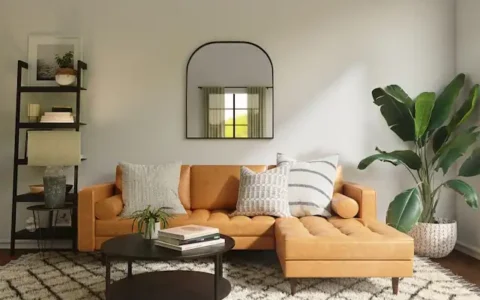
Turns out I was making almost every interior design mistake that exists for small spaces. Not one or two – most of them. Simultaneously. In one room.
If your living room feels cramped, awkward, cheap-looking, or just… off – despite your best efforts – this list is for you. These are the real interior design mistakes I’ve learned to spot, the ones that make a room feel smaller than it is, and the specific fixes that actually moved the needle. Not theoretical fixes. Things I’ve tested in real apartments, on real budgets, with real constraints.
Table of Contents :
15 Interior Design Mistakes Ruining Your Small Living Room (And Smart Fixes That Actually Work)
1. Your Rug Is Too Small – and It’s Shrinking Your Entire Room
I cried in a HomeGoods once. Not proud of it. But I had spent three months trying to fix a room that just kept looking wrong, kept feeling like a collection of furniture rather than a room, and I couldn’t figure out why. (It was the rug. It was always the rug.)
A rug that’s too small – the classic 5×7 under a full sofa grouping – does something visually brutal. It makes your furniture look like it’s floating, unanchored, randomly placed. The room reads as unintentional even when you’ve thought carefully about everything else. What designers mean by visual weight is this: your furniture needs something grounding it to the floor. The rug is that anchor.
The fix: In a small living room, go for at least an 8×10 rug – ideally one where all four legs of your major furniture pieces sit on it, or at minimum the front two legs of the sofa and chairs. If budget is a concern (and good rugs are genuinely expensive – quality wool starts around $300-500 and goes up fast), look at synthetic flatweaves in the $100-200 range. They won’t feel as luxurious underfoot, but they’ll do the spatial work. Jute is beautiful and affordable but sheds noticeably for the first several months – worth knowing before you commit.
Renter tip: Layering a smaller textured rug on top of a larger, neutral base rug is a designer trick that actually works on real budgets. It adds depth without requiring one perfect expensive rug to do all the work.
2. Every Light Source Is Overhead – and It’s Making the Room Feel Institutional
Overhead lighting only – that single flush mount or recessed light punching down from the center of the ceiling – is the fastest way to make a living room feel like a waiting room. Harsh. Flat. Uninviting. The problem isn’t the brightness, it’s the angle. Light coming from above creates unflattering shadows and removes what lighting designers call layered lighting – the combination of ambient, task, and accent sources that makes a space feel warm and dimensional.
What actually works is building light at multiple heights. A floor lamp in the corner (warm bulbs, 2700-3000K – that amber glow that reads as “evening” rather than “fluorescent office”) does more for a room’s feeling than almost anything else. Add a table lamp on an end table. If you have floating shelves or a bookcase, a small plug-in light tucked inside adds accent lighting that makes the whole room feel considered.
Budget reality: A good floor lamp runs $60-150 for something solid. Spending $30 on warm-toned LED bulbs to replace whatever came with your fixtures costs almost nothing and is the single highest-return change in any room.
Dimmer switches change everything – but that’s a modification, so renters should check their lease first. Plug-in dimmer adapters exist for table lamps and sidestep this entirely.
3. You’ve Pushed All the Furniture Against the Walls
This feels logical. Small room – push everything out, create space in the middle. I did this for years. It makes the room look bigger in a photograph and smaller in real life, which is almost the opposite of what you want.
Here’s what’s actually happening: when furniture hugs every wall, you lose what designers call the conversation distance – seating should sit within roughly 8-10 feet of each other for the space to feel like a room rather than a hallway with furniture on the sides. You also lose the negative space between pieces, the breathing room that makes a design feel intentional rather than crammed.
The fix: Pull your sofa 6-12 inches off the wall. Even that small gap reads differently. Float your seating arrangement toward the center of the room, grouping pieces around your coffee table. Yes, the space behind the sofa will feel awkward at first – a slim console table back there turns it into an asset instead of a problem.
4. Your Sofa Is the Wrong Scale for the Room
Not gonna lie – this took me way longer to figure out than it should have. I kept buying sofas based on how they looked in showrooms or photos, completely ignoring the actual dimensions printed on the tag. Then I’d spend two months living with something that dominated every sightline in my apartment before accepting I’d made a mistake.
Scale and proportion – how your furniture’s size relates to both the room and the other pieces around it – is one of the most powerful things at work in any room. A sofa that’s too large for a small living room doesn’t just look big; it makes the entire space feel claustrophobic. The room organizes itself around the sofa’s scale rather than the other way around.
Before buying anything over 84 inches wide, measure your room and tape out the footprint on the floor. Live with the tape for a day. See how it feels. And measure your doorway (and hallway, and any corners in between). Nothing teaches this lesson like having to return a sectional because it physically could not enter the apartment. (I’ve heard this happens to people. Theoretically.)
Small-space tip: Look for sofas described as “apartment-scale” or “loveseat-scale” – typically 72-80 inches – with raised legs. The legs are important: they create visual breathing room underneath, making the whole piece feel lighter.
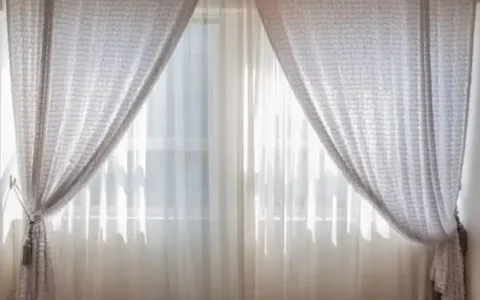
5. Your Curtains Are Hung Too Low and Too Narrow
This one sounds small. It isn’t. The placement of your curtain rod does more for the perceived height and elegance of a room than almost any other single choice. Most people hang curtains just above the window frame – following the logic that the curtain is covering the window. But curtains aren’t just functional. They’re vertical architectural elements, and their placement signals ceiling height to the eye.
Hang your rod as close to the ceiling as possible – even right at the ceiling if you can manage it. And hang it wider than the window opening, 6-12 inches on each side, so that when the curtains are open, they stack on the wall and let the full window breathe. Suddenly a standard 8-foot ceiling reads taller. A modest window reads larger. The whole room feels more considered.
Budget fix: Long curtains that graze the floor run $30-80 at most retailers in neutral linen-look or sheer fabrics. The rod hardware is where I’d spend a little more – $40-60 for something that feels solid – because cheap rods visually cheapen the entire window treatment.
Renter note: Tension rods can work for lighter curtains. Command hooks can support lightweight rods. But for anything heavy or very wide, you’ll likely need to drill – worth a conversation with your landlord, since most are fine with properly patched holes.
6. There’s No Focal Point – So the Eye Doesn’t Know Where to Go
Walk into a room and your eye does something automatic: it looks for a place to land. Something to orient around. When designers talk about creating a focal point, they mean establishing one clear visual anchor that organizes everything else. In living rooms, this is often a fireplace, a TV, an art piece, or a dramatic window. In small living rooms without any of those, it can feel like everything competes equally for attention – which reads as chaotic and unsettled.
The fix is less about adding something dramatic and more about committing. Pick one wall and make it clearly the “main” wall. Hang a larger piece of art there – something that reads from across the room – or create a gallery arrangement centered on that wall. Position your seating to face it. Even a large mirror, hung intentionally with a lamp on each side, creates the anchoring effect without requiring you to own original art.
7. You’re Blocking Your Natural Light
Okay, I have a strong opinion about this one. Furniture placement relative to windows is one of the first things I look at when a room feels off – and it’s almost never discussed in the same breath as light. People carefully choose the right curtains and then push a bookcase directly in front of the window because it “fit” there spatially.
Natural light is your most valuable interior design asset in any small space. It makes colors accurate, ceilings feel higher, and rooms feel larger. Blocking it – with heavy furniture, dark window treatments you leave closed, or shelving crowded into window alcoves – works against everything else you’re trying to do.
The rule I follow now: Nothing over about 36 inches tall lives within 3 feet of a window. The window stays clear from its sides. Furniture is placed to allow light to travel through the room, not stop at the first obstacle.
8. Too Many Small Decor Pieces Instead of a Few Meaningful Ones
I remember standing in my living room at 11pm, having rearranged seventeen small objects on my coffee table for the fourth time that week, genuinely wondering if I just didn’t have the eye for this. Turns out the problem wasn’t arrangement. The problem was quantity.
Small decor pieces – the collection of little candles, the five tiny plants in individual pots, the scattered coasters and trinkets – read as clutter in small spaces, no matter how carefully arranged. Each individual item is perfectly nice. Together, they create visual noise that exhausts the eye and makes the room feel busy and small.
The designer answer is fewer, larger, more intentional pieces. One statement plant instead of six small ones. One larger candle rather than a cluster of votives. Three books stacked with one object on top instead of twelve books and eight objects. This is what negative space actually means in practice – it’s not emptiness, it’s the breathing room around objects that lets them be seen individually.
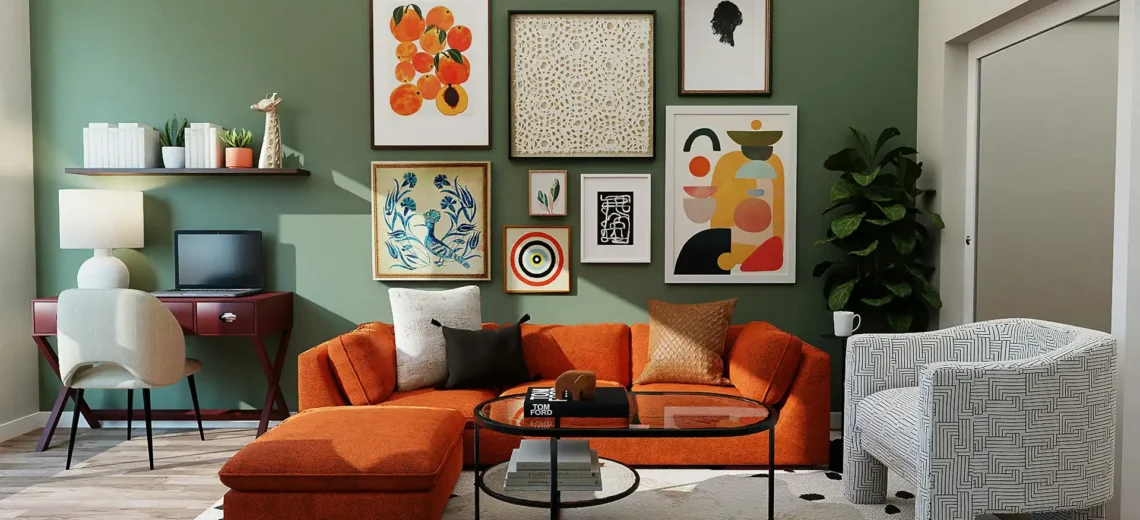
9. Your Gallery Wall Is Overwhelming the Space
Gallery walls photograph beautifully and can feel genuinely curated when done well. In small living rooms, they can also overwhelm – especially when the arrangement is dense, the frames are many different sizes and finishes, and the whole thing competes with every other surface in the room.
Nobody talks about this enough, but the scale relationship between a gallery wall and the room matters as much as the individual pieces. In a small space, a gallery wall that covers an entire wall floor-to-ceiling reads as dense and heavy. The fix isn’t necessarily to remove it – it’s to simplify. Fewer frames. More consistent framing (same finish, or a tight range of two). More breathing room between pieces. Or consider three large pieces in a simple horizontal line instead of fifteen small ones in an elaborate arrangement.
10. You’re Using Trendy Decor Instead of Building a Base
I’ve been there: saw something on Pinterest, bought it, built a whole room around it, regretted it eighteen months later when the trend had moved on. The living room that felt “terracotta boho” in one season felt dated the next. Not because terracotta is bad – it’s genuinely beautiful – but because I’d treated a trend color as a foundation rather than an accent.
In small living rooms especially, the 60-30-10 rule is your structural backbone: roughly 60% of the room in a dominant neutral (walls, major furniture, rug), 30% in a secondary tone that gives it personality, and 10% in accent pieces where trend can live safely. The accent layer – pillows, a throw, a few accessories – is what you swap out when trends shift. The base stays. This is how a room stays feeling intentional across several years without full overhauls.
Trendy colors are beautiful in their moment. Just let them be the 10%, not the 60%.
Before You Keep Scrolling: The Thing That Ties All of This Together
Here’s something I’ve noticed across every small living room I’ve worked on, including my own: people treat each of these problems as separate. The rug is wrong, so they fix the rug. Then the lighting feels off, so they address the lighting. Then the layout still feels awkward.
But these problems aren’t separate. They compound each other – and they resolve each other. A correctly sized rug and pulled-in furniture arrangement and layered lighting and a clear focal point don’t just each improve the room a little. They work together, and the effect is multiplied. The room suddenly feels like it was designed rather than assembled.
The one mistake that undermines everything else – the thing almost no list mentions – is treating small-space decorating as a series of isolated fixes. The room is a system. Everything in it relates to everything else. Which means the best thing you can do is step back and look at the whole, not just address the most obvious problem and call it done.
Pick two or three of these to address at once, preferably ones that interact – rug size, furniture placement, and lighting, for example. The cumulative shift will feel dramatic even if the individual changes feel modest.
11. You’re Ignoring Vertical Space
Small rooms are often short on floor space and rich in vertical space that never gets used. The wall between 5 feet and the ceiling is essentially untouched in most apartments – and that’s real estate that can do serious design work without using any floor area.
Floating shelves mounted high on the wall draw the eye upward, making ceilings feel taller. Tall, narrow bookcases do the same. Curtains hung at ceiling height (see mistake #5). Art hung slightly higher than feels comfortable at first. All of these are vertical space strategies, and in small rooms they’re often more effective than any horizontal rearrangement.
Renter note: Most floating shelf installations require wall anchors. Get written landlord approval, or use freestanding ladder shelves that lean against the wall and require zero drilling. They’ve gotten genuinely stylish in recent years.
12. Your Coffee Table Is Doing Nothing for Storage or Flow
The coffee table in a small living room needs to work harder than its larger-room counterpart. A solid block of wood or glass in the center of a tight seating arrangement can feel like an obstacle rather than an asset – especially if it doesn’t offer any storage benefit.
What I’ve found actually works in small spaces: either a smaller, legged coffee table (those legs again – visual lightness matters) or an ottoman with storage inside. The ottoman approach is underused and genuinely great: it’s softer, it functions as extra seating when you need it, and the storage inside handles the throw blankets, remotes, and random items that otherwise pile up on surfaces.
Traffic flow matters here too. Designers aim for about 18 inches of clearance between the sofa and coffee table, and 2-3 feet of clear pathway around the furniture grouping. In a small room, these numbers feel impossible – but even approximating them makes the room easier to move through, which makes it feel less cramped.
13. The Color Temperature in Your Room Is Fighting Itself
This is the kind of thing that’s genuinely invisible until you know to look for it – and then you can’t unsee it. Color temperature refers to the warmth or coolness of both paint colors and light sources, measured in Kelvins for bulbs and visible in undertones for paint. When these fight each other, rooms feel unsettled in a way that’s hard to name.
Warm bulbs (2700-3000K) with warm-toned paint (creamy whites, greige, warm beige) create coherence. Cool bulbs (4000K+) with cool-toned paint (bright white, cool gray, blue-gray) do the same. What doesn’t work: warm paint with cool daylight bulbs, or cool-white walls with amber Edison bulbs. The colors literally compete, and the room reads as inconsistent even with good furniture and layout.
I got this completely wrong for years. I’d choose a paint color under natural daylight in the store and then wonder why it looked different in my apartment at night. The light source changes everything. Test your paint samples under the actual lighting conditions of the room, at the times of day you use it most.
14. You Have No Texture – Just Flat Surfaces and Flat Walls
A room with beautiful proportions, a good rug, and the right furniture can still feel cold and a little lifeless if everything in it has the same visual texture. Texture contrast – mixing rough with smooth, matte with shine, natural with manufactured – is what creates the warmth and depth that photographs well and feels even better in person.
In a small living room on a budget, this doesn’t require anything expensive. A chunky knit throw over a smooth linen sofa. A jute rug under a sleek glass coffee table. Aged brass hardware against matte walls. Distressed wood on a floating shelf beside clean white paint. The contrast between materials is what creates the feeling of a layered, collected space rather than a showroom floor.
A note on durability that most decor articles skip: if you’re choosing upholstery fabric, the number that actually predicts longevity is the double-rub rating – a measure of how much abrasion the fabric can withstand before showing wear. Performance fabrics rated for 50,000+ double rubs handle real everyday use. Most budget upholstery sits around 15,000 double rubs – fine for a low-traffic bedroom chair, genuinely problematic for a sofa in your main living space.
15. You’ve Never Established Clear Zones in a Multi-Purpose Space
This one applies especially to studio apartments and living rooms that double as offices, reading nooks, or dining areas. Without what designers call zoning – visually separating different functions within one open space – a multi-purpose room reads as chaotic, its different purposes canceling each other out rather than coexisting.
Zoning doesn’t require walls or room dividers (though a well-placed bookcase can do exactly that). A rug defines a seating zone. A pendant light or floor lamp marks a reading corner. A small desk with its own chair and task lighting creates an office zone that feels distinct from the living area even when they’re six feet apart. The zones signal to the brain that this space is organized and intentional – which makes it feel larger and calmer, not smaller.
Your Interior Design Mistakes Quick-Check Before You’re Done
- ☐ One clear focal point established – your eye knows where to land when you enter the room
- ☐ Rug properly sized – front legs of major furniture pieces sit on it at minimum
- ☐ At least 3 light sources that aren’t all overhead
- ☐ Curtains hung close to ceiling height, wider than the window frame
- ☐ Clear 18-inch clearance around coffee table, 2-3 ft pathways throughout
- ☐ No surface overcrowded – negative space is visible somewhere
- ☐ At least two texture contrasts present (rough/smooth, matte/shine, natural/manufactured)
- ☐ Furniture pulled slightly off walls, not pinned to every edge
- ☐ Scale of largest furniture piece feels proportionate to room – not dominating every sightline
You Can Check Also :
Small Living Room Layout Mistakes to Avoid (And What to Do Instead)
The Ultimate Guide to Decorating Your Living Room on a Budget
The Stuff Nobody Tells You About Interior Design Mistakes in Small Spaces
The fix you need might not be the fix you think you need. I spent a year obsessing over paint colors in an apartment that actually needed better lighting and a correctly-sized rug. The paint was fine. I kept solving the wrong problem because paint is visible and easy to name. The real issues were subtler – which is true of most small-space problems. If you’ve tried one fix and the room still feels off, step back and look at what you haven’t touched yet.
Photos lie in both directions. Things that look incredible in curated Instagram photos – extremely dense gallery walls, dark moody paint in tiny rooms, very low furniture – can be genuinely difficult to live with. And things that feel amazing in person – a good rug, layered warm lighting, breathing room between furniture pieces – often look unremarkable in photos. Design your room to be lived in first. The photos are secondary.
The honest budget truth. I’ve spent more on certain rooms than I’ve ever admitted publicly, and they still didn’t feel right for six months. Budget matters, but it’s not the variable I used to think it was. Some of the most impactful changes I’ve made – repositioning furniture, swapping bulbs to 2700K, hanging curtains at ceiling height – cost almost nothing. Some of the least impactful cost quite a bit. The ROI on home decor is genuinely unpredictable, which is both humbling and liberating. More expensive doesn’t mean more right for your space.
Your room will tell you what it needs – if you slow down enough to listen. I’ve learned more from sitting in an uncomfortable room and really looking at it than from any design book. Where does your eye keep going? What feels wrong? What makes you walk past without wanting to sit down? These aren’t vague feelings – they’re data. Your discomfort with a space is specific, even when it’s hard to articulate. Start there.
Interior Design Mistakes: Questions I Get Asked All the Time
Q: Can a small living room actually look designer on a real budget, or do good results require real money?
A: Genuinely – yes, within limits. The changes that make the biggest spatial impact (curtain placement, lighting layering, furniture arrangement, rug sizing) cost relatively little or nothing. Where budget shows up is in material quality and longevity – a $60 rug does the spatial work but won’t feel the same underfoot or last as long as a $300 wool version. You can make a small room feel considered and intentional on a limited budget. You can’t necessarily make it feel luxurious without spending something on a few key pieces.
Q: What’s the single most impactful change for a small living room that feels cramped?
A: It depends on the room, and I know that’s an unsatisfying answer – but it’s true. If I had to guess without seeing the space: rug size and furniture placement together. Pull your sofa off the wall, make sure your rug is big enough to anchor the grouping, and ensure there’s a clear traffic path. That combination does more than almost anything else because it changes how the room feels to move through, not just how it looks standing still.
Q: Is dark paint really that bad in a small living room?
A: Controversial take: not always. Dark paint in a small space with poor lighting and small windows will feel heavy and closed in. Dark paint in a small space with good layered lighting, high-hung curtains, and strategic mirrors can feel intimate and intentional rather than small. The paint color is almost never the problem on its own – it’s the light and the spatial choices around it that determine whether dark reads as cozy or claustrophobic. I’ve seen this go both ways in spaces of nearly identical size.
Q: How do I make a rental living room feel like mine without being able to change anything permanently?
A: More is possible than most people realize. Removable peel-and-stick wallpaper has genuinely improved – some versions look nearly identical to traditional wallpaper at normal viewing distance. Command strip picture hanging (the large strips, rated for heavier items) handles most art. Freestanding furniture does everything a built-in would do. Large rugs cover bad flooring. Curtains hung with tension rods or landlord-approved command hooks transform windows. The real constraint is what you can patch invisibly when you leave – and most small holes from properly-hung picture hooks fall into that category.
One Last Thing Before You Go Fix Your Living Room
The more time I’ve spent paying attention to interior design mistakes – in my own spaces and others – the more I’ve come to believe that most of these aren’t about taste or talent. They’re about information. Nobody sat most of us down and explained why a rug needs to be bigger than feels comfortable, or why curtains hung at window height undermine a whole room, or why pushing furniture against every wall creates the opposite of the spacious feeling you’re after.
You now have that information. Which means you’re already ahead of where I was for my first several apartments.
The work of applying any of this is slower and more iterative than a single blog post can capture. You’ll try one fix and realize it reveals another problem. You’ll get the rug right and notice the lighting more clearly. That’s not failure – that’s how rooms actually come together. Slowly, by paying attention to what feels off and addressing it one layer at a time.
Pick one thing from this list. Just one. See how it shifts the room. Then come back to the rest.
Which mistake are you tackling first? Drop it in the comments – I’d love to hear what you’re working with.