This article may contain affiliate links. If you purchase through a link, I may earn a small commission at no extra cost to you. Read my full Affiliate Disclosure.
My friend Maya walked into my living room, looked at the windows, and said, “Oh, your rod is just really low.”
That was it. That was the whole thing. Two years, two sets of replacement panels, one full room repaint, and somewhere around $300 spent trying to figure out why my living room felt so cramped and sad, and the answer was four words from someone who’d known it the second she walked in.
I stood there for a second. And then I laughed. And then, honestly, I felt a little sick.
Table of Contents :
Why I Kept Getting This Wrong
I moved into this house thinking I knew enough about decorating to handle it myself. I’d done a course in interior design fundamentals. I’d watched approximately one million YouTube videos. I owned a level and I was not afraid to use it.
So when I hung my first curtain rod, I did what felt logical. I measured the window frame, I centered the rod a couple of inches above it, and I hung the panels. Done. Looked fine to me. Normal, even.
What I didn’t understand, and genuinely had never thought about, was that “a couple of inches above the window frame” and “as close to the ceiling as possible” are two completely different things, with completely different results. I had the knowledge to hang the rod. I had no understanding of what rod height actually does to a room.
I thought curtains were about covering a window. I didn’t understand yet that they’re about making a room.
What Actually Happened (The Unfiltered Version)
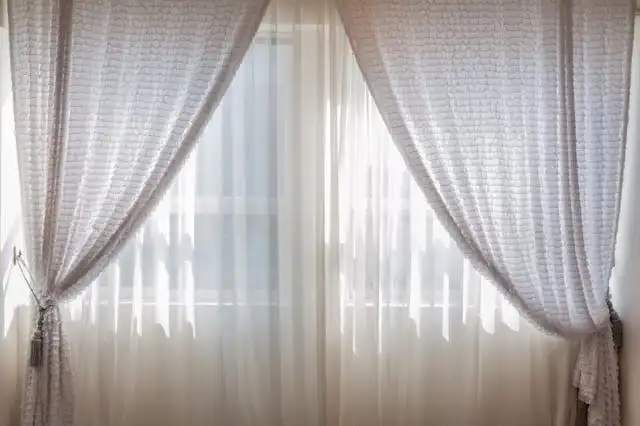
The first panels were ivory linen, and I loved them right up until I didn’t. They looked okay in photos. In real life, the ceiling in that room felt low. The windows felt small. The whole space felt a little pinched, though I couldn’t have told you why.
I blamed the color. Repainted from a warm white to a softer greige, which did help the overall feel but didn’t fix the ceiling. Still low. Still pinched.
Then I decided the panels were the problem. They weren’t the right length, I told myself. They were ending too far off the floor and that was making things look wrong. So I spent around $90 on a second set, slightly longer, same basic color family. Rehung them. Still low. Still pinched.
This is the part I’m a little embarrassed about: I actually started wondering if the room just had bad bones. Like, maybe the proportions were off and nothing would ever fix it. I’d essentially diagnosed the room as a lost cause and started thinking about what furniture I could rearrange instead.
And then Maya came over.
She walked in, glanced at the windows the way someone glances at a spelling error, and said her four words. I asked her what she meant. She pointed up, toward the ceiling, and said, “Rods go way up there. Makes the ceiling feel taller. Yours are sitting right on the frame.”
I looked. She was right. My rods were barely four inches above the window trim, which meant my panels were hanging in the middle of the wall, cutting the room in half visually, making everything feel shorter and smaller than it actually was.
She moved one rod herself, right then, to show me. Slid it up near the ceiling, rehung the panel. And I just, I stood there. I finally understood what people mean when they talk about vertical lines drawing the eye up. The window didn’t look bigger because the room got bigger. It looked bigger because the curtain was leading my eye up to the ceiling instead of stopping it halfway.
Two years. It took me two years and a friend visiting on a Wednesday afternoon to learn this.
The rehang took about 45 minutes. Three rounds of patching the old holes, a couple of wall anchors, and it was done. The room looked taller. The windows looked bigger. The ceiling that I had mentally written off as too low was suddenly fine.
I sat on the sofa afterward and felt genuinely annoyed at myself. Not in a fun, laughing-at-your-mistakes way. In a quiet, “I wasted real money and real time on the wrong problems” way.
What This Taught Me About Curtains (And Honestly, More Than That)
The first lesson is the obvious one: hang rods high, ideally within four to six inches of the ceiling, and extend them out past the window frame on each side so the panels stack off the glass when open. This is not a style preference. It’s the difference between a room that breathes and one that doesn’t.
But the lesson underneath that one is harder to say out loud.
I kept buying and repainting and rearranging because those felt like doing something. Returning a curtain rod and rehanging it two feet higher felt too simple. It felt like it couldn’t possibly be the answer. And that instinct cost me probably $200 in panels I didn’t need and a full weekend I spent repainting a room that didn’t need to be repainted.
The honest thing is: I was solving for the wrong problem because I hadn’t correctly identified the actual problem. I kept treating symptoms. The room feels small, so change the color. The room feels off, so buy new panels. I never stopped to ask what was actually creating the feeling in the first place.
And the third thing, the one I’m most reluctant to write: I probably could have found this out in ten minutes of research. But I was confident enough in what I’d already done that I didn’t look it up. I assumed I’d hung them correctly because I’d hung them carefully. Careful and correct are not the same thing.
If You’re in the Same Situation, Start Here
Before you buy new panels, before you repaint, before you decide your room just has bad bones: check where your rod is.
Measure from the top of your rod to the ceiling. If it’s more than six or seven inches, move it up. This is the single highest-impact change you can make to a room and it costs nothing except a round of patching.
Let your panels puddle slightly or just touch the floor. Panels that hover too far off the floor create the same energy as low rods, just at the bottom. The eye needs to travel the full length of the wall for the trick to work.
Extend the rod past the frame, at least six inches on each side if your wall space allows it. This lets the panels stack completely off the glass when open, making the window look wider and letting in more light.
Budget reality: if you’re rehanging existing panels, you’re looking at new wall anchors and maybe some spackle for the old holes, probably under $15. If your current panels are too short after raising the rod, which is likely, new panels in a linen or cotton blend in a neutral run $50 to $150 for two, depending on where you shop. That’s it. That’s the whole cost.
Give yourself one afternoon, not a full weekend. Measure twice before you put a single new hole in the wall, and you’ll be fine.
If I had to name the single most important thing: hang higher than feels right. Your instinct will tell you it’s too high. It’s not.
This approach makes less sense if you have very low ceilings already and can’t gain much height, or if you’re renting and patching holes repeatedly isn’t something your lease allows. In that case, look into ceiling-mounted curtain tracks, which are more renter-friendly and achieve a similar effect.
My Honest Verdict
Was it worth it? The time and money I spent before Maya visited? No. Not even a little.
But the lesson I carry now is genuinely useful and I use it every time I walk into a room, mine or anyone else’s. I notice low rods everywhere. I see exactly what they’re doing to a space. That’s worth something.
Would I have gotten here eventually without Maya? Maybe. But I’d probably have bought a third set of panels first.
This is not a difficult fix. That’s the most frustrating part and also the most useful part. If your room feels smaller than it should, if the windows feel underwhelming, if something is just off and you’ve been blaming everything else, check the rod height first. Don’t repaint. Don’t replace. Don’t do what I did.
I still think about that Wednesday afternoon more than I probably should. Not with embarrassment anymore, mostly with something like gratitude, because Maya is the kind of friend who just says the true thing instead of being polite about it.
If you’ve been living with curtains that feel wrong and you haven’t been able to name why, I’d genuinely love to know what you figure out. Drop it in the comments. I read all of them, and real talk only, some of the best things I’ve learned about decorating have come from other people saying the simple thing I was too close to see.